


Q.
Hi George,
Pre. S. -- You were a clue on Jeopardy the other day! It made me once again reflect on how lucky we are to be able to just send you questions.
My question has to do with engaging with writing from authors we know to be some level of “problematic.” The list is (unfortunately) long -- Mary Karr describes abuse from David Foster Wallace, Cormac McCarthy had some kind of relationship with a 16-year-old when he was in his 40s, Alice Munro stayed with her child’s abuser, and so on.
You’ve written before about the incongruity of judging someone like Chekhov against today’s moral standards, but I think that’s different from this.
On the one hand, there’s lots of writers, and maybe we don’t need to spend time reading ones like those listed above. On the other hand, the idea of applying some moral purity test before deciding who to read feels anti-art and boring. And for that matter where does the line get drawn, do we have a list of moral transgressions which are okay, and some that aren’t, and if someone is an even better writer we’re ok with worse behavior because of their talent?
I’m curious for your thoughts on this! The “GS method,” and the way you generally talk about how a writer writes makes me think you’re not one to argue that art can be separated from the artist. At the same time, maybe the writing can exist in a vacuum, and its relationship to its writer doesn’t actually have to impact us as readers.
P.S. No one got the Jeopardy clue. Not story clubbers.
A.
I can always tell when I’m a Jeopardy clue because I hear from many old friends, from all over the country. Thanks, Jeopardy! Always a thrill.
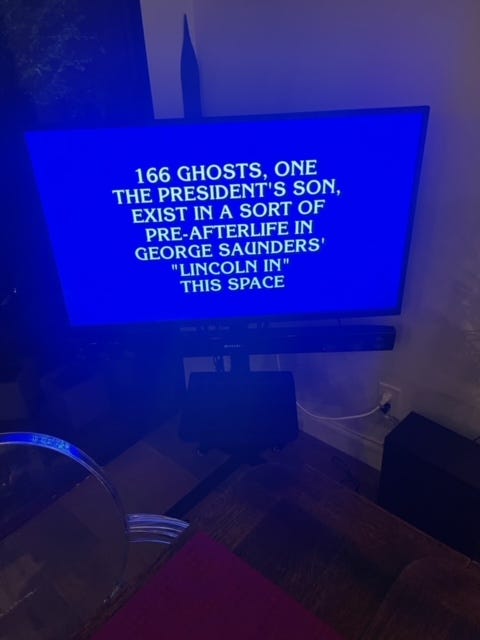

First, let me say that my heartfelt answer to this question is simply: everyone should approach this in whatever way they want to, end of story. We can decide not to read a certain writer, for whatever reason, or we can decide to go ahead, ditto. It really isn’t for anyone else to say.
It’s interesting the way that the world these days seems to make us feel that we need to have an opinion on everything, even when having a certain opinion may not change anything we do, or anything about the way the world responds.
We seem to be losing the ability or desire to just be silent on certain questions. (Silent and sad; silent and interested; silent and alert.)
On the other hand, that view makes for a pretty short post. 😊
So, allow me a few exploratory thoughts on this, just to widen the conversation a bit.
As I’ve often said, here and other places, one of the beautiful things about art is the way that our practice can allow us to lift out of our normal, habitual selves and into someone better/more interesting.
So, it doesn’t surprise me that certain artists might have presented “better” on the page than in real life. Nor that people who have, at times in their lives, behaved in ways that are not ideal/perfect/admirable can, at other times, in that artistic mode, make works of art that are original, intense, wonderful.
Making a good work of art does not involve moral perfection, it would seem.
It requires artistic power – and that power may appear in someone imperfect, even abhorrent.
When I was a student, years ago, at West Texas State University, just making my way into writing, I somehow stumbled on the work of Louis-Ferdinand Celine, specifically his novel, Journey to the End of the Night. I was literally wandering through the stacks of the library, had heard the name Celine, saw the book, and stood there reading it. It sort of blew my mind: that conversational, sassy tone. Something popped open in my head, of the “Wait, you can do that?” variety. I’d been feeling trapped by my internalized expectation that writing had to be perfect, neat, formal, elevated, etc. I didn’t check the book out, never finished it – just read the five first pages, while standing there, and that did the trick. Not long after, inspired by that little bit of “permission giving,” I wrote the (sassy, conversational) short story that would later get me into the Syracuse program.
Only later (years later) did I find out that Celine was a bit of a turd – a collaborationist and an anti-Semite.
But…those five pages had changed the trajectory of my life, regardless of their source.
Would I “unread” them, if I could? Absolutely not.
So, it seems to me, two thoughts can co-exist: 1) I like this writing, and 2) I don’t like the person who wrote it.
What seems to be at the heart of your question, dear Questioner, is this: How are we supposed to think about artists? Who are they to us? What do we want or expect them to do for us?
I don’t think “be a moral role model” is my answer. I can go elsewhere for that. History is full of great artists who, at some time or another, or in this area or that, were stinkers.
What I want to find in a work of art is the feeling that a person – the person the artist was in “real life”– lifted off, by way of craft, and transcended that day-to-day self, and left behind some beautiful detrital evidence of that (temporary) transformation – in the form of the work of art.
So, there’s the person in real life, and the person that person becomes when working. Are they the same? I think each of us who has been an artist has had some sense that they are not.
We seem to especially want our fiction writers to be moral paragons/ role models/wisdom-sources. This is, I think, because of language. All of that language – nuanced, specific, directed, seemingly, at us – makes us feel that a person who writes a good story must have some sort of inside track on morality; a good story feels wise; it feels, often, noble, kind, transcendent.
So it’s natural to want to ascribe those qualities to the person who wrote the story. (“How could he have modeled and explored those virtues so vividly on the page if he didn’t have a handle on them in real life?”)
And, actually, we’re right to do so, as long as we remember that “the person who wrote it” doesn’t exist and never did – that entity just appeared, at moments during the writing, and then receded when the writing was done. That entity accrued over the time that the artist worked on the story – that writing-entity, really, was a temporary construction, that might have had very little to do with who the artist was when he or she finished for the day and went back into the world.
“The artist” is a sort of ghost who appears during working hours, we might say.
And that ghost is what we admire.
So, a person might be, as you put it, “problematic,” in real life, and yet manage to do something important artistically, in the same way that someone can be a tremendous musician or athlete or painter in spite of their personal defects.
We get disappointed when we confuse that ghost and the person who walks away from the desk.
I find that my life is simplified if, when I’m tempted to have an opinion, I ask myself why I need one, and what I aim to do with it. If there’s nothing to do with it, I try not to get too worked up (not crazy about theoretical opinions).
In this case, once I have ruled out the idea of choosing certain writers to be role models, I’m left with a simpler question: Should I read this person? That is: should I read the work of this person about whom I may know something negative (or regretful, or outright disgusting)?
Which begs another question: why do we choose to read a certain writer? Well, and: why do we read?
I read for edification and pleasure and to advance my art. And I somehow feel that I have to allow myself access to everything, as I pursue the aim of, someday, writing something truly great.
For example, I love Alice Munro’s story “Dance of the Happy Shades” – loved it the first time I read it, and every time since, and I know I’ve learned a lot from it.
I was really saddened to learn the fact you mention above – that she knew about the abuse of her daughter and yet reunited with the abuser. This was heart-droppingly disappointing. It made me put aside the idea that, because Munro’s stories feel so wise and insightful, that she should be taken as a sort of moral-ethical role model. (And it made me wonder, also: Why did I ever have that idea in the first place?)
However (thought experiment): has the story gotten worse? I think that would be a hard case to make. The story hasn’t changed. It’s still exactly the same story it was the first time I read it, long before I knew any of that stuff about Munro’s personal life.
So, what do I do? Never read it again? Well, I could make that decision. (And so could you, with my blessing; maybe you already have). But if I felt there was something to learn from re-reading it, it would seem strange to me that I would deny myself that. (Who benefits? How is justice served?) Ditto, if I felt my students might benefit from a close reading of it, would it be wise for me to not teach it to them?
A strange conundrum.
The truth is, I read that story before I knew what I now know about Munro, and found it technically and morally wonderful. Are those feelings undone by these revelations? (In a funny way, they sort of are; it will be hard to read any of her stories, including “Dance of the Happy Shade,” without that thing floating over them.) On the other hand, that story, and many of her stories, seem to exist in fields of interest that don’t intersect with that thing. Or is that even possible?
Now, there are categories of her stories that concern the very thing she did – that involve abused daughters and mothers reacting to that, and so on. To tell the truth, I haven’t read all of her work and haven’t read those particular stories. My guess is, if we read them closely, we might be able to detect some falseness or avoidance in them – something would not ring true, or the language might go a little hazy in places. (It might actually be an interesting exercise: to try to find the “tells” in those stories, if they exist.)
But I’m not sure. Maybe she was a good enough craftsperson that she could shape the story in such a way that kept the falseness or denial at bay. (A story is, after all, a short and limited performance, a bit like showing up at a party; easier, in that setting, to briefly dazzle.)
Every so often I get a student who declares that he or she won’t read this or that type of writer – it’s against their principles. In these cases, I gently try to make the case I made above, by suggesting that it would be a shame if a writer had something to offer them, in this incredibly difficult journey they’re on to find their own way and their own voice, and they declined to take it.
If that persuades, it persuades. If it doesn’t, that’s fine too – I just assume that this is, also, an important part of the student’s artistic journey, this refusal, this drawing of a line for one’s self.
I’ve found it a good teaching attitude: to let a student do whatever he or she wants. This can be a sort of artistic judo, to let a student passionately indulge his or her own view (in reading, in editing, in subject matter), even if I feel they’re “wrong,” or may come to my view of things eventually. (And sometimes they do, and they write to me even years later to let me know).
In the end, an artist is always going to have to go it alone, and has to use her own stuff to make progress – including her own resistances and tenderness around certain topics, her own instincts about what she wants to read and what she doesn’t.
One thing we artists are always doing is burning through our own bad ideas, on the way to the better ones.
The more I think about it, the more I feel: I will read what I like and be happy when other people read what they like, or don’t read what they don’t like. It’s all fine with me; these are private decisions. Also: I will avoid the trap of confusing artist with person.
I’m a great believer in our ability to keep several thoughts alive at the same time; in our ability to discuss, work through things, take this and leave that, and so on – I am less interested in judging and disqualifying than I am in trying to get to the bottom of a thing, staying open, entertaining contradictions within myself…
I’m very interested in hearing what you all think about this, Story Club. Because I value your opinions very much.
Are there writers you refuse to read? Why? Do you have (as our Questioner put it) a “list of moral transgressions which are okay, and some that aren’t?” Do you feel that “if someone is an even better writer” you’re “o.k. with worse behavior because of their talent?”
Munro's own childhood was brutal. The abuse she suffered was ritualized and sadistic. That doesn't forgive or excuse the harm she caused her children but it does contextualize it. Humans are flawed and resilient and messy and shameful and heroic. I hope we can keep finding room for the complexity.
I'm thinking about the story "Vandals" (which I'm sure other people are thinking of, too). I did reread it after I learned about Munro and her daughter, and I don't think it's hazy or avoidant. I don't think that the reason Munro writes so well about betraying trust is because she betrayed the trust of a child--I think it's because she would have written well about any experience she'd had. I mean to say that I don't think dark experiences are necessary for writers (although experiences with high stakes probably are). There's a line in that story where the character, Bea, thinks that, "she could have spread safety" ... for the children who are molested by her lover--a character whose name (a smart friend pointed out) is almost an anagram of her actual husband's name. Bea could have, but she didn't. I remembered that line recently when I was working with a student who was writing an essay about an abusive parent, and so I repeated it to her. She understood it immediately. It's not that it helped the situation--but we don't really rely on stories for that. I think we rely on them to clarify our experience. That student didn't know about Alice Munro's family history, and most likely she never will. If the line stays with her in a clarifying way, then maybe the story is doing its job, in spite of the reprehensible actions of its author.