


Finalizing this post in Grand Forks, North Dakota, where I just had the honor of participating in the University of North Dakota Writers Conference - which was founded in 1970 and has been happening continuously ever since.
Someone gave me a record of the writers who’ve attended over the years, and the entry for 1975 caught my eye: John Barth, Wendell Berry, William Gass, Ken Kesey, N. Scott Momaday, Ismael Reed, and Alice Walker (!). And 1978 wasn’t bad either: John Ashberry, Amiri Baraka, William Burroughs, Ring Lardner, Jr., and Story Club favorites Tillie Olsen, and Eudora Welty.
A great privilege to attend, meet so many nice people, and be interviewed by the wonderful Amber Sparks, author of (among other books) Happy People Don’t Live Here.

I will now sleep for three hours, and get (I hope) on the 5 am flight back home.
But first, our question of the week!
Q.
My question is thus: are we finally allowed to drop the quotation marks? (which remind me of prison bars). After reading Vigil and Prophet Song by Paul Lynch I can’t help but notice that the bars have been taken off. In the case of Prophet Song even the “He said, She said,” is gone. In Vigil you are necessarily stuck with Mel G and Mel R and a cast of thousands so perhaps there’s no way around it. Dialog can create nice space on the page (except in P Song where the intended effect is claustrophobic). But I always hate having to load “he said, she saids” into the flow of my dialog or having to come up with some clever workaround like - “You are completely to blame for my confusion,” he vocalized while reading his mental etch-a-sketch. “You are a pain in the…”, Susan slammed the door.
It seems you were dealing with these questions while writing and at the readings. What do you think? Are the rules loosening? Are we finding our way to a bright new dawn? Will the editors let us go there?
A.
I think we are allowed to do whatever we want, no exceptions.
Of course, we have to deal with the fallout from that. And we might want to have some rationale for any sort of departure from convention – not a logical, articulated rationale, but even just a hunch – a hunch that this will be better than that.
Part of the fun, with art, is to do something a little verboten or naughty and then make it work – the reader feels that, I think, and likes the panache of it, especially if that departure isn’t just random.

In my case, I make the “quotation marks or not” decision on a case-by-case basis, truly. It’s just a decision I make as I get to the first bit of talking. My “rationale” is just that it feels right, whichever way that decision goes. Vigil has none; a recent story, “Thursday,” does use quotation marks. There’s probably some deep rationale but I don’t know what it is.
But let’s talk “fallout.”
I don’t think editors generally object to the no-quote-mark convention, which has been around since at least the stories in Dubliners by James Joyce, and probably long before that.
The advantage of not using quote marks has something to do with the non-interruptive nature of that convention. Because the spoken words aren’t announcing themselves as such, they are just one more component of the visual, on-page, presentation…or of the associated verbalism that occurs there in our head, as we read, which sometimes feels right.
I personally don’t mind the “he said/she saids” (and don’t love it when I can’t figure out who is saying a line) but am not crazy about adding things to them….you know: “Get thee behind me,” he exclaimed/ejaculated/burst out.
I feel that the tone of a statement should be implied by the words themselves. I don’t mind the repetition of the identifiers and, in fact, I think these can be part of the larger poetry of a dialogue section – we just have to take them into account, treating them as of equal sonic value as the spoken bit. (Hemingway is a master of this, by the way.)
In other words, we try to make the whole dialogue swath, identifiers included, read with good rhythm and sound, including the identifiers.
With Vigil, I could make the case that most, nearly all, of the “talking” isn’t talking at all but a sort of psychic mental exchange between different dead characters and sometimes KJ Boone. But that argument doesn’t hold up, since the speech of the living characters isn’t indicated with quotation marks either. (I think I tried that, at one point, but it felt intrusive and off.)
With any departure from the norm, we want to think, as courteously as possible, about its effect on the reader.
I’ve read a good number of student stories in which the writer has decided to eschew quote marks. My job there, as I edit, is to identify places where the convention is making it unnecessarily hard on the reader, usually by not making it clear where the talking starts and ends. (Sometimes this might be the intention but I think usually not).
So, say we have:
I never want to see you again, Rick said. You’re always borrowing money and not paying it back. A dog across the street turned around in three quick circles. And it’s not like I’m made of money. The dog barked, sat, began to whine. That’s it.
Well, to my ear, the writer is making it hard for no payoff. If he’d just said:
I never want to see you again, Rick said. You’re always borrowing money and not paying it back.
A dog across the street turned around in three quick circles.
And it’s not like I’m made of money.
The dog barked, sat, began to whine.
That’s it.
…is that better? A little. But for clarity, I’d do it with the speech identifiers (the “he said/she said” part).
I never want to see you again, Rick said. You’re always borrowing money and not paying it back.
A dog across the street turned around in three quick circles.
And it’s not like I’m made of money, Rick said.
The dog barked, sat, began to whine.
That’s it, Rick said.
But, truly: it’s up to us.
The larger principle is this: we are allowed to do anything. Will there sometimes be a cost (to clarity, to readerly engagement, to our publication prospects). There will! Should we take these into account? I think we should, especially if clarity, readerly engagement, and/or our publication prospects matter to us.
I remember once seeing Frank Conroy teach a class. He drew this big arc on the board with a “W” on one end (for WRITER) and an “R” on the other (for READER) and he said that any work is going to fall somewhere on the arc - either trying to please the writer (maybe a difficult, self-referring work like, say, Finnegan’s Wake) or the reader (an easy, popular, very accessible airport read). Conroy then said, “You might be thinking you should split the difference, and put your book right in the middle of the arc.” But no: he wasn’t suggesting that but, rather, saying that, you could put your book wherever you liked, only you had to accept the consequences. If you put it way over on the W side - don’t complain when no one else but you can make sense of it and it doesn’t sell. If you opt to put it way over on the R side - don’t complain if you fail to get high-end literary cred.
But you, the writer, get to choose. Period.
Often, when I’ve done something odd in a story, I just say, “OK, oddness – you’re in for now. But I’m going to have to ask you to justify your existence.” That is, it doesn’t feel like I’m doing that “just because” or to distinguish myself as an edgy, rebel-of-a-writer who doesn’t care about what anyone thinks of him. No: I am someone who is working hard to use the entire pallet of effects available to me, in order to make my story more special and original.
I can give a quick example. When I first started Vigil, I had the book in the same format as Lincoln in the Bardo and there were two ghosts in attendance at the bedside of: a dead guy from the 19th Century (who could have stepped right out of Lincoln in the Bardo) and a younger, working-class woman who’d died in the 1970s.
After working on this model for a few weeks, it finally dawned on me that the book didn’t require that structure (it hadn’t “asked for it” in the way that LitB had). And it felt very slow in that format.
So I decided to choose one narrator and stick with that person.
I chose the woman – Jill “Doll” Blaine. But then I found I was having trouble cutting certain bits of the male dialogue – I liked the sound of it and it did a perfect job of setting certain things up.
So (and here’s the accommodation of the non-normal mode): I just dropped the bits I liked from the male speaker into the female speaker. And made a note: That’s weird and will eventually have to go, unless it earns its keep.
I left it like that for quite awhile, always softly asking myself, “Why is she talking so weird?”
In time – spoiler alert – it became clear that she herself contained two consciousnesses – one from her actual (now ended) life, one from her current state (angelic/ghostly/”elevated.”)
That development in the book was suggested by the anomaly in the prose, in other words.
So: excess that occurs to us by way of feeling….and then some textual reason for that excess to be there (which makes it not an excess).
So, I don’t know about that “bright new dawn” but I think that, if we believe in the choice we’ve made, and accept all of its consequences, editors will, yes, happily go there with us.
Thoughts about this, Story Club?
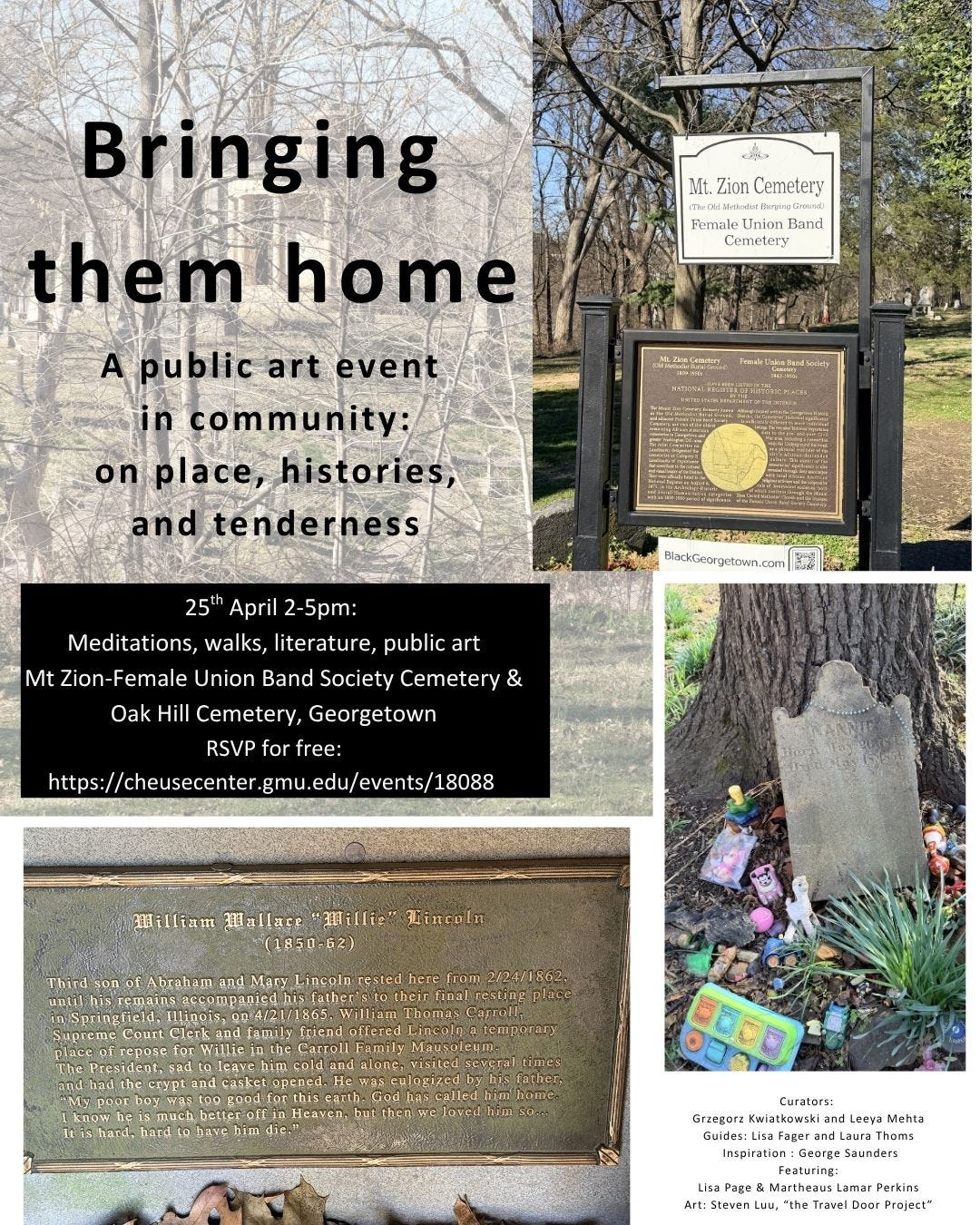
A few quick announcements - first, of this interesting event happening in D.C. on Saturday, April 25, 2026 2:00 PM to 5:00 PM:
More details here.
I won’t be there except in spirit but have lots of affection and admiration for the organizers - and love anything that honors Oak Hill (where Lincoln in the Bardo was set) and Mt. Zion.
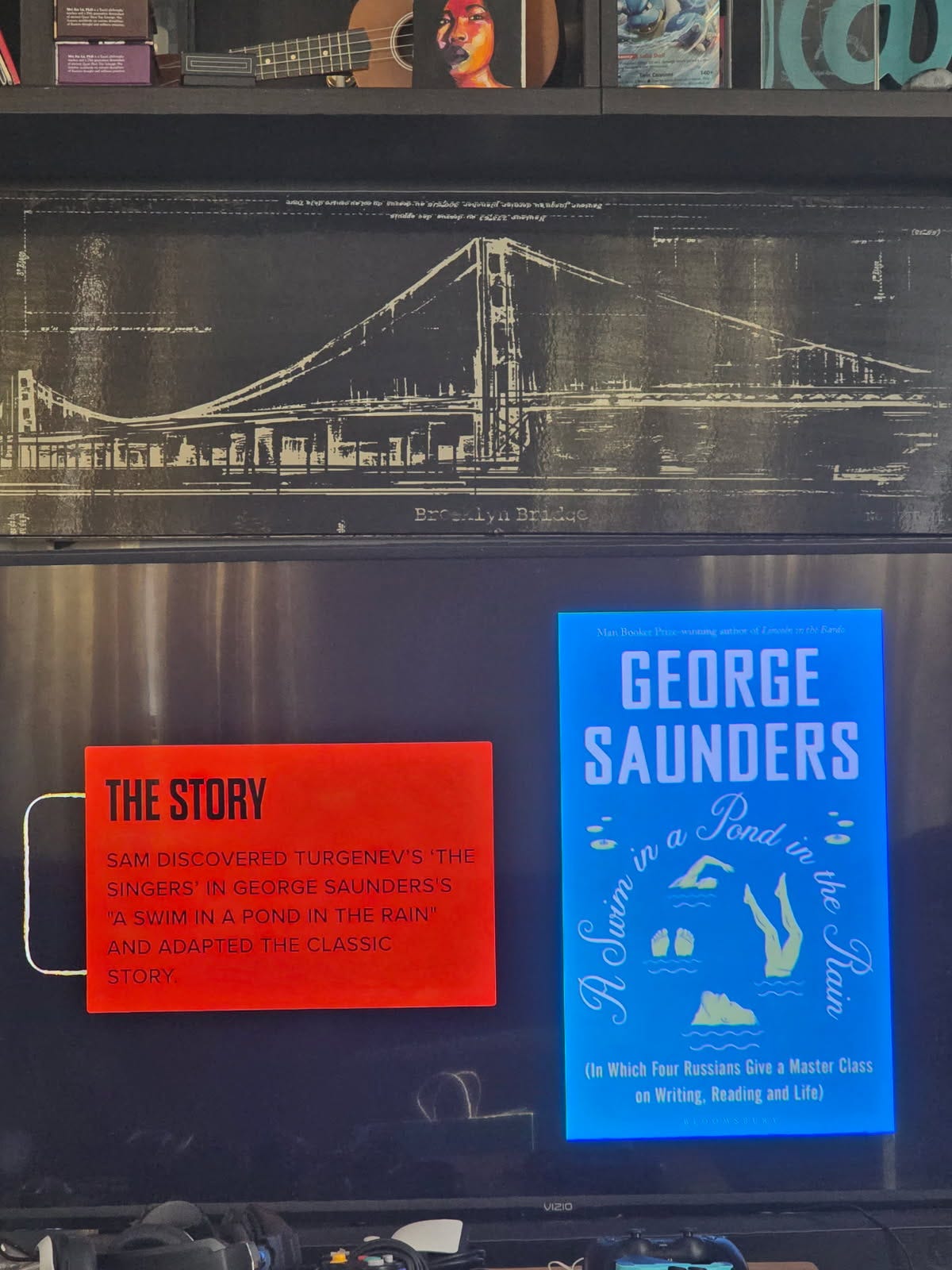
Some of you may have noticed that the short film The Singers, based on the Turgenev story featured in A Swim in a Pond in the Rain, won an Oscar last week. It’s a lovely film and congrats to everyone involved.
Re: quotation marks. Yes, I agree you can do as you please. Some books confusing without, others ok. While proofreading for one editor, I suggested cleaning up a few things and he said, Nah, leave it. They can figure it out. Seems to me that is exactly what the editor's job is, to be sure everything is clear enough that readers do not have to try to figure it out. So I didn't tell him when I fixed some dialogue. But the PhD interviewed expressed gratitude for the clean up. She remembered having flubbed a bit. It's a matter of having an ear for the dialogue and context, and getting the ego and trendsetting out of the way.
It was so cool to realize that the short film streaming and nominated was based on the story we read. “The cast and production is fantastic,” she said.