


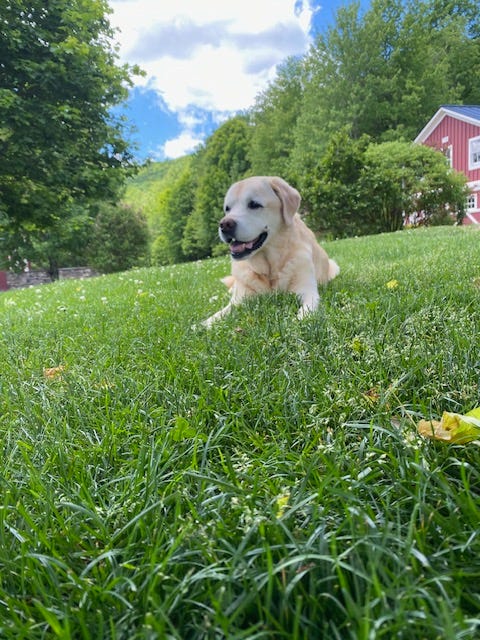
First, thanks for all of the warm wishes for Guin, who is having a pretty good week, all things considered. She’s fourteen and, a little over a year ago, had a blood clot in her lungs, and developed pulmonary hypertension. She sends her love and thanks. She is a real fighter, with a truly gentle heart. We are doing our very best for her, and so is she, for us.

Second, I wanted to let you all know that I’ll be posting a link here on June 22 for single-show purchase of tickets for the Met Opera’s production of Lincoln in the Bardo. The opening is October 19 – would love to see and meet some of you there. It should be a great party.
Third, a few months back I had the privilege of reading a galley copy of Ann Patchett’s new novel, Whistler , out this week. And it is a beauty.
The critics agree:
A rave by Helen Schulman in the New York Times..
Another here by Priscilla Gilman in the Boston Globe.….
And yet another here, by Ron Charles, at his excellent Substack.
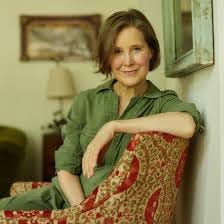
What these reviews both pick up on, and what makes Ann’s work so rare and indispensable, is her unparalleled ability to represent human decency – to write entire books that feel accurately scaled to what real life feels like – no easy villains, no cynicism, lots of beautiful things (nature, emotion, friendship, humor) and characters intelligent enough to notice, and be grateful for, these gifts of grace.
The books are laced with gratitude, but it’s a realistic, non-soppy gratitude – the kind we all feel when, now and then, things go right, and we feel a beneficence acting in the universe that can’t be denied. The books also show hardship, and regret, and loss, all of that but, for my money, there’s nobody who suffuses those representations with more adult human functionality, more compassion, than Ann does. It takes a monumental spirit to write about the genuinely good, in a time when the superficial bad can sometimes seem to be winning. When I finish one of Ann’s books, I feel challenged to be more open to positive phenomenon – more open, that is, to the potential within me, more in touch with the things in life that are good and beneficial – less auto-snarky, let’s say.
In Whistler, I feel like Ann has done what great artists do – take the thing that only they can do and do it more purely. It’s a gorgeous story of friendship and recovery of affection, and it’s also a page-turner, in which the drama, for me, was all about tracking the author to see if she could make tension with such benevolent materials (she could) and about watching that sort of shadow-of-the-author emerge on the wall as the story was told.
Every novel is really the author making a claim about the way the world is, and the way we might exist in it, and how we might live in authentic relation to its truth; the shadow Ann’s author-self makes on the wall is one if immense confidence, and love, and faith that a person can indeed go through life loving the people and things of this world, and there is no weakness in that position, only the most profound strength.
The triumph of the novel is that there is nowhere in it in which the book or author strains to be uplifting or good – it just is, she just is.
It’s a perfect, artfully minimal expression of a current that has been running through Ann’s work since the beginning, here realized so beautifully that it makes me grateful to be alive in the same artistic world as her.
In other words: I recommend it with all my heart.

One thing I try to do to improve my teaching is to watch myself as I work, and then, in the classroom, be completely honest about what I found back at the work table.
This week, I noticed something that I thought I’d share, that might have to do especially with stories that are weird – that are non-realistic and require an additional level of buy-in from the reader.
What I noticed was that many (most) of my edits were in the service of simple believability – to make it so that the reader didn’t flinch or withdraw belief at that image or phrase. I found myself going through my text-in-progress again and again, as usual, but this week I noticed that mostly what I was asking myself was, “Would I believe it?” That is: “After reading this sentence, am I still under the spell of the story? Or am I beginning to smell “author at work?”
A few closer, frank, unrefined observations about this mode of editing:
1) It has everything to do with the feeling I have as I read, rather than with rational thought.
2) The solution is often omission – if a bit is proving hard to sell, I’ll try to cut it or go around it – this might indicate that the story wants to go in a simpler, easier-to-swallow direction.
3) Likewise on the sentence level: simpler “sells” better (sometimes). I’ll sometimes find that I’ve tried to cram too much into a sentence, which causes the CLEVER! Indicator to shoot way up, which causes the BELIEF! indicator to drop like a stone.
4) Sometimes I can distract from an unlikely event or image by way of humor. Or, sometimes a particularly good sentence – lyrical or original – will do the trick. If this happens – if the reader (that is, me, as I re-read) is charmed enough to accept the new fact or image because of its nice packaging – that new sentence or phrase is in (in the story).
5) I am always looking for something elemental (of a sentence, a scene, a plot development)…a simple version, that the reader will accept rather automatically, because it feels correct/mythic/unadorned. Not embellished or heavily ornamented but just sort of “first-order there.” Reading it, the reader just goes, “Oh, wow, that just happened, oh boy!” instead of “Wait, could that even happen?”
6) In that same spirit, I always try to make things happen in the most quotidian or logical way. I try to make characters do things for the obvious reasons, or react realistically to events. And this seems especially true for stories with especially strange premises. It’s sort of a strategy of limiting the weirdness in a story. (If there are flying rabbits, let everything else in the story be just like our world – something like that – the reader will only accept so much non-normative stuff, maybe?)
7) Sometimes belief is engendered by letting the story and its characters express resistance, and then having the story rise to meet it. (If the reader is doubting Assertion A, let another character challenge Assertion A.) There are some giant ants the size of skyscrapers in your story. You fear the reader may resist, since ants that big don’t exist in the world. Have one character says, “But giant ants don’t exist!” Then, even if another character just says, “I know, right?” the reader feels that their resistance has been noted.
8) The main thing is to see, as I’m re-reading, if I would believe it. If I don’t, I don’t. It’s visceral – the same kind of assessing-for-truth one does in a real conversation. Disbelief is indicated by this slight internal wince as I’m reading, like…”Nah. Nope. No, it didn’t. No, it wouldn’t.” Another way of saying this: I imagine my reader going, “Ech, that’s bullshit,” and closing the book.
9) This feeling I’m calling disbelief can also be associated with a moment when my agenda is suddenly showing. Suddenly there’s the author and their Big Plan, sticking out like a sore thumb. And I see that the event didn’t organically, “really” happen – the author just needed it to happen. (Even if that author was me).
10) If something can’t be told in such a way that the reader will believe it, then it’s not allowed in the story. The events that end up in a story are the ones that survived the believability test – they also, for reasons I can’t explain, tend to be, in the end, the ones that guide the story to its highest meaning.
There’s nothing fancy about this process, at least not for me. It’s just trying out a sentence that indicates an event and then either 1) believing it or 2) recoiling because I don’t believe it/some resistance has arisen. Then I try to say it in another way – more subtle, less showy. I will try to cut the offending words (the ones that made my resistance rise). I might find myself looking askance at the larger structural unit that led to this moment. Then, eventually, if there’s no fixing it (no making it so that I would believe it) – I cut it and make way for something else (or sometimes that whole section has to be reconsidered, or moved, or set aside for later).
The idea, I guess, is that by the time I’m done, there should be no, uh, Belief Bumps, let’s call them, in the whole story.
Allow me to close with a specific example, from my story “CommComm” (which we’ve discussed here at length before ).
There is a moment on page 205 of the collection the story appears in, which is called In Persuasion Nation.
The first-person narrator works in an Air Force office which has been filled for a day or two with a bad and mysterious odor. We’re about to find out that the smell is coming from two dead bodies hidden in a closet.
Now that’s a tough sell. Why? Well, one, it’s unlikely, doesn’t happen much, etc. Two, because it feels sort of movie-esque, you know? DEAD BODIES! It feels like the author is trying to ratchet up the import of the story (which, believe me, he was).
So here’s the bit. (Rimney, by the way, is the first-person narrator’s boss, and we’ll soon find out that he’s the one who found the bodies and hid them in the closet. Rimney’s been under a lot of pressure to report this bad smell to a department called Odors and he has been resisting, to the extent that, earlier in the story, he pretends to call them.)
Beginning of story text:
“You might have noticed earlier that I was not actually calling Odors,” Rimney says.
“I did notice that,” I say.
“Thing I like about you, you’re a guy who understands life gets complicated,” he says. “Got a minute? I need to show you something.”
I follow him back to CommComm. Which still stinks I follow him into the copier closer, which stinks even worse.
In the closet is something big, in bubble-wrap.
“Not to self,” he says. “Bubble-wrap? Not smell-preventing.”
End of story text.
I’d say that, by this point, as a reader, my resistance to belief has been surmounted. I just want to know what’s inside the bubble-wrap.
I wrote this story a long time ago, so I can look at it pretty objectively now, and say that the work of softening the reader’s resistance is done by way of a few discrete steps:
First, Rimney (at “You might have noticed earlier….”) brings the reader’s attention back to the smell. (He’s enacting #6, above.). And we understand that, whatever happens next, is going to be about that – his way of directly addressing this issue.
Second, there are a series of facts, having to do with the smell, that are facts, and are therefore hard to resist: CommComm does stink, it still stinks, the stink gets worse as we follow Rimney, to what he seems to be claiming is the source of the stink.
Then there’s this: “In the closet is something big, in bubble-wrap,” that, and the associated joke about bubble-wrap not being smell-preventing, are somehow mundane and real enough (and the slightly odd look of the word “bubble-wrap” on the page is also doing some work) to make me open up to whatever’s coming next (whatever turns out to be inside that bubble-wrap). It’s almost as if the surprise of that word makes me believe in the reality of that “something big” in there, and suddenly I’ve gone past doubting it exists, to wanting to know what’s inside it.
Then we’re going to get the news that there are bodies in there.
Now, to my ear, if the next bit goes:
“He slits open the bubble-wrap. Inside are two dead bodies,”….my belief slightly tails off. I feel, “Ah, this writer is trying to make his story more intense by way of introducing a murder” or something like that.
Whereas, if I say it this way:
“He slits open the bubble-wrap. Inside is this giant dirt clod” (I’m wondering what this clod is). “Sticking out of the clod is a shoe.” (OK, well, I see, and can accept, a shoe.) “In the shoe is a foot” (Yep, I see it.) And it’s a “rotting foot” which makes me see it (believe in it) that much more and ditto that “rotted sock.”
Also, the rhythm of the paragraph is somehow convincing:
“He slits open the bubble-wrap. Inside is this giant dirt clod. Sticking out of the clod is a shoe. In the shoe is a foot, a rooted foot, in a rotted sock.”
And then, there’s something about this next line that’s belief-enhancing:
“I don’t get it,” I say.
I think that’s because the reader does get it. (It’s dead bodies, stupid!) This also gives Rimney a chance to quickly provide an explanation (the bodies were found down in a construction site):
“Found down in the Dirksen excavation,” he says. “Thought I could stash them in here a few days, but phew.”
Again – that “phew” does a lot of work for me, somehow. (See #4 in the list above). It’s almost as if, re a hard-to-sell bit, there’s a spoonful-of-sugar aspect – a funny or particularly witty/unusual word choice is the sugar, for the medicine that is the hard-to-believe factoid you are trying to get the reader to swallow.
Compare this to:
In the copier closet were two dead bodies.
“From the Dirksen excavation,” he says.
I feel the authorial agenda lurking there, somehow.
Anyway, that passage goes on, and if you find it you’ll see that I’m using this same ethos throughout – hard-to-buy factoid gets softened with surprising word choice. On the next page, for example, the two men agree that the two corpses “look old-timey.”
All of this just to introduce this concept of believability as one aspect (dominant, I realized this week) of my editing process. And also to introduce the idea that….well, we all have our secrets. Sometimes we think “editing” just means “making something more true” or “introducing more of my own hard-won, real-life wisdom.”
But this belief thing is, for me, not that…and it’s deep. It has something to do with my choice of stories (I somehow find that I often want to tell big, exceptional, funny, genre-laced stories) but also with my personality – I’ve always been a people-pleaser and I feel that I intuitively know how to make you believe me, even if (God forbid) what I’m telling you isn’t true. That’s a life-skill I developed, for better or worse, that is (I think and hope) being used for good in my stories (while I try to expunge it in real life).
I’d love to hear similar thoughts from you on the deep, hidden, perhaps shameful, private methods and feelings you apply when you are editing, i.e., facing down a sentence that you wrote yesterday, that is subject to being changed today, in our continual pursuit of excellence. 😊
Oh, and finally (sorry for the long post): a reminder that, over beyond the negligible paywall, we are engaged in a great discussion of a story called “Feelings,” by the marvelous Ruth Ozeki. The story is from her new collection, The Typing Lady, which just came out last week. Join us for some great talk about compassion in writing, and sympathy, and point-of-view, among many other things. We got a beautiful note from Ruth last time, about the genesis of the story, and on Sunday she’ll be answering some of our Story Club-generated questions on the craft of the story.
I appreciate the time and effort you’ve put into Ann Patchett and her latest book, which I can’t wait to read. When I read Tom Lake, I thought it was the most loving book I’d ever read, and it surprised me that I had the thought. I don’t usually rate books based on being loving, but was struck by it with this one. Also Orbital. And I felt it with Lincoln in the Bardo. Unbidden, but I think it matters. We need to put the love in the world to counteract all the stuff that’s being spewed around out there.
The one thing I’ve noticed is that it’s very difficult for me to edit something I wrote yesterday. It’s much easier to edit something I wrote last week or even last month. Which I guess means that although I certainly do editing daily, the practice of slightly improving sentences day by day rarely results in a finished, good story. I often need to put a story away for weeks or months (sometimes years) before the big edits happen. Although of course I realize that these two approaches are complementary, not contradictory.