
Summoning the Impossible Hippo
"The Stone Boy," #3


Last time I posed a question: how does Gina Berriault make us believe in the accident on which “The Stone Boy” depends?
We’ve talked in past posts about reducing the worry and anxiety associated with writing. Here’s a thought that reduces my stress level: my first job as a writer is to make the reader believe in the reality of the thing I’m narrating. That’s it. Without that, nothing else can happen. No theme, no plot, no politics. If I make her believe this incident, and then the next one, and those events have some causal connection – that’s a story, basically. If the reader believes, and causality exists, rising action will occur (in theory).
So, how did Berriault do it?
A few thoughts below, most of which you’ve already touched on in your wonderful discussion in the Comments, but let’s try to summarize/put them all in one place:
She Makes Us Expect It
At the top of page 268, at the line, “Arnold lifted his .22-caliber rifle from the rack on the kitchen wall,” I’m put in mind (as, per the Comments, many of you were) of Chekhov’s maxim, “If in the first act you have hung a pistol on the wall, then in the following one it should be fired. Otherwise, don't put it there.”
Stories seem to work this way: if something gets introduced, we expect it to be used. If a story begins, “I woke that morning to find a hippo in the kitchen,” we expect to see that hippo again. It has become, God love it, a story element.
Furthermore, even if you are hippo-skeptical, you have already, at my mention of it, begun to accept the hippo’s reality, and have moved on to the question, “Well, all right, but what, George, do you plan to do with that thing?” In a sense, you have “granted me” that hippo. Now that it’s real, or semi-real, to you, you are that much more willing to believe it, if I tell you the hippo suddenly starts brewing a pot of coffee.

Having Made Us Expect Something, She Makes it Happen Sooner than Expected
Seeing Arnold’s gun, I wait for it to go off. This becomes a source of tension, a ticking clock: “Ah, jeez, I’m pretty sure that gun’s going to go off. But when? And who, or what, is going to get shot?”
Part of me expects that this is the story’s plan for itself: to gradually lead up to the big shooting.
But no. Suddenly, the gun goes off, there at the bottom of the third page (page 269), as I am passing through that wire fence, with Arnold, pages before I expected it to.
And it’s wonderful, being taken by surprise like that. I don’t have time to doubt the reality of the shooting; my energy is busy processing the surprise. And I’m suddenly that much more in Berriault’s power. I have a new respect for her. Knowing what I was expecting, she shocked the hell out of me, by delivering it more quickly than I expected.
This is a decent lesson for any writer: if you’ve made the reader expect something, make it happen soon(er).
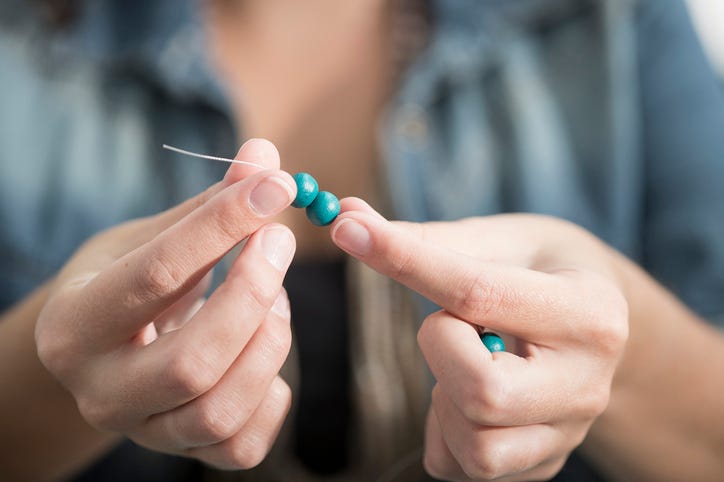
When I was a kid in Chicago back in the 1970s, we used to make these things called “chokers” or “love beads.” You’d tie a knot at one end of the string, add a bead, slide it all the way down the length of the string, to the knot. I sometimes think of these chokers in a writing context, with the self-admonition: “Always push the bead to the knot.” (In Hollywood, I believe they say something like, “Always play your aces.”) If you have some idea of what’s going to happen, make it happen now. Sometimes we horde these events, thinking they’re all we have. (I see this in student stories that are working toward some big reveal at the end; the middle portions of these storiesoften feels aimless and withholding. A better move is to trust that, if we play our aces/push the bead to the knot, the story (generous friend that it is) will always have more – and better – to give us.
We might understand this idea in relation to the recent post re: joy vs. fear: playing that ace is a way of forcing oneself into originality. Or, we might say, if we refuse to do the “safe” thing (i.e., horde the surprise) we are, at least, not doing that. We are, we might say, creating a space for originality by refusing to concede to predictability. And, in that move, the story (because you have given it no choice) starts being about something else - something other than the reveal of that surprise.
This is true of “The Stone Boy;” instead of being (merely) a nail-biter about when the gun will go off, it becomes a deep meditation on what happens afterward – the guilt and shame and the role of community and so on. And because we grasp that the shooting is not “load-bearing,” I think we accept it more easily. It’s not what the story is about; rather, it has to happen so the story can be about what it really wants to be about.
Now, as is true of so many other writerly maxims, please take “always push the bead to the knot” not as a rule, but a law (as this word is used in physics) – it describes a general tendency of fiction. We shouldn’t think “I must always push the bead to the knot/reveal my surprises quicker,” but, rather, “I might want to think about cultivating a skill for this, and then use that skill with discretion.”
She Then Slightly Misdirects Us
If you reread pages 268-269, you’ll see that Berriault subtly sets up a secondary expectation (in addition to “that gun is going to go off”): the boys are going to shoot a duck, if they can find one. This has the effect of directing our attention past the current moment, down toward the lake, at “the shocks of wheat that covered the slope,” at “the rushes that formed an island in the center” (of the lake), and then we find that, hooray, yes, there are, indeed, ducks down there, “four wild ducks swimming out from the willows into open water,” and so, as we creep down with the boys, “from one shock of wheat to the other,” my mind, anyway, has become preoccupied with a new question: “Will Arnold get his duck?” This calms me a bit, re: the question of when the gun will go off, i.e., I am now imagining it will go off as soon as we get down to the lake, and that it will be pointed at a duck.
Eugie makes short work of the wire fence, and we/Arnold, follow, with a slight, anxious feeling that we need to hurry, since, as usual, we’re being left behind by our more capable older brother.
(A little side-assignment: can you reconstruct where your mind’s eye was, in that moment where Arnold was passing through the fence? With him? Inside him? Beside him? Over there with Eugie, looking back?)
She Underplays the Shooting
Note the simple, matter-of-fact language in which the tragedy is presented: “His rifle caught on the wire and he jerked at it. The air was rocked by the sound of the shot.” Likewise, no drama in Eugie’s death: he falls to his knees, pitches forward, claws at the ground, and is dead, although that word is not used, because that word is not in Arnold’s mind, because it has not yet occurred to him that “dead” is what Eugie is. There’s no emotion in this sequence except that Arnold feels “foolish.” He anticipates the “expected shower of derision from his brother.” He is still in that old, dead world, where Eugie is alive and is still his brother. This suppression of emotion is exactly the point: this moment won’t become real to Arnold until late that night (page 278). The event is only: the rifle catching, his jerking at the rifle, and a sound. All sense data, no interpretation.
The way Berriault has written this tells us that what the rest of the world will soon label as callousness in Arnold is actually shock. It takes his feelings all that time to catch up reality (which speaks to the enormity of the loss) and, when he does start feeling what he should…it’s too late.
We might note the way the reading mind processes this matter-of-fact tone, as opposed to the way it would have processed a more flamboyant or “written” one, like, you know: “And then, in a moment that would forevermore resonate down the increasingly dark corridor that would soon become Arnold’s life, with the sound of what seemed like a thousand cannons breaking the holy silence of the morning….”
Arnold’s Reaction Distracts and Further Convinces Us
Once we realize that Eugie is dead, we expect Arnold to rush home for help. When he doesn’t … it’s interesting. It’s more interesting. It forces the story to ask a new question: “What’s up with this kid?” In a sense, we retroactively accept the gunshot because we see that, in narrative terms, Eugie’s death is giving us that timeless literary feeling: “Holy shit, what’s going to happen next?”
Now What?
Over the first five-and-a-half pages (pages 267-272): a boy accidentally shoots his brother, goes off to pick peas, tells his parents, hides in the barn, is called down. It’s vivid and heartbreaking and, for some of the reasons mentioned above, we believe it.
Now what?
As we, students of the short story, pause at that narrative break on page 272, we find ourselves at an interesting place. We’re about to cross over into the true land of the short story. Suddenly the story is asking a question: What happens to a kid who has killed his brother? Or, more generally: what happens to any of us, when we’ve made a grave mistake? When the complexity and randomness of life has put us in an unbearable position? We’ve just seen Arnold suffer through this, our hearts are going out to him, this kid who seems to be in shock, in denial, and we wonder: Who is going to help him through this? And: What is the nature of the help that might be given? Is there any such help?


On our next scheduled posting date, February 24, we’ve been given the opportunity to cross-post with LitHub. So I think I’ll take a break from “The Stone Boy,” to write something about an idea I’ve mentioned in the Comments from time to time: so-called (by me) “avoidance moments.”
Please comment further on “The Stone Boy” here, if you like, and, if you have any questions about the story that you’d like me to take up, let me know. I think we’ll do one or two more session on it, and then move on to talk about revision, and do some exercises.
I have to go now - the hippo in the kitchen is apparently bent on making omelets and needs me to run to the store for “a whole, whole lot more eggs.” Apparently, he’s a fan of the “super-big omelet.” Whatever that is…
I have to say, on my first reading of "The Stone Boy," (was it only a week ago?) I did not think of Chekhov's gun, not right away. When Arnold plucked his rifle off the gun rack I thought of Murphy's Law. This is why I believed: I have seen over and over again how anything that can go wrong will. A nine-year-old with a rifle immediately seemed like bad news.
Another thing I noticed immediately was the tender beauty of the language. "The mountains behind the farm made the sun climb a long way to show itself." Lines like this brought me fully into the world of the story. I knew where I was, and with whom.
It is interesting that Arnold sleeps naked. (I didn't start doing that until I was fifteen!) Something about this makes him even more painfully vulnerable. I like that Gina started out with that.
It's also interesting--and telling--that in the beginning, Arnold seems wide awake, and Eugene is only semi-conscious.
Gina's attention to detail in the paragraph in which the gun goes off is stunning. Clambering through the fence. The sonic blow of the shot. Arnold lifting his face, to take the verbal abuse. Eugene falling, pitching forward. The ducks rising up, calling, the beat of their wings. I think this is another reason I did not question anything; I was part of the scene.
"It was a warmth on his back, like a large hand laid firmly there, that made him raise his head." This also felt perfectly real. "Arnold lay still as a fugitive, listening to the cows eating close by. If his parents never called him, he thought, he would stay up in the loft forever, out of the way. In the night he would sneak down for a drink of water from the faucet over the trough and for whatever food they left for him by the barn." Again, this feels exactly like the mind of a nine-year-old boy. 'I will accept my punishment. I am no longer fit to live among my people. I will stay out of their way. I will only eat if they leave me their scraps.'
The scene where Arnold tries to speak to his mother is at least as heart-wrenching as any of the others, perhaps more so. Gina's gift is that everyone in the story does exactly what they can do, but it is not enough. "He had expected her to tell him to come in and allow him to dig his head into her blankets and tell her about the terror he had felt when he had knelt beside his brother." This astonishing flashback to what he had felt when he realized Eugie had died--had felt but could not know, or process, at the time. (I think, many years ago, it took me weeks, if not months, to know not just in my mind but in my body, in all of my being, that my lover was truly, fatally, completely dead, and not coming back.) It's catching up with him now, yet no one can see it. And he realizes his nakedness, and so do we. And he must flee the light of his father's lantern.
"Then he went out the door and down the back steps, frightened by his answer." I am frightened by it, too. All I can see is a string of years and decades, flattened out, and empty, unless there is a bird or willow or a body or a body of water that can save him, or a memory of his brother. A line of music, or a book. But I believe that more than one person who has read this story may have been saved by it; or might have been able through forgiveness or understanding to save someone else.
In college, I took a class called “Film and Literature” which met weekly. On odd weeks, we watched a film adapted from a text source (novel, story, letter, poem, essay); on even weeks, we’d invite a guest speaker to talk about her field in a way she thought would be of value/interest to people interested in film translation. One of the guest speaker weeks was — by itself — worth all four years of tuition.
Our speaker was a professor in the History of Art department who specialized in 19th-century French art. He strode onto the stage and, without introduction, projected a slide of two black charcoal smudges, one on top of the other snowman-style, against a pure white background. No scenery or detail; no lighting; just the two round smudges.
After a minute of silence, he asked, “What is this a picture of?” Silence. None of us wanted to make a fool of ourselves.
“Alright…let me make it easier. Is this a person, place, or thing?” After some hemming and hawing, we voted that it was probably a person.
“What kind of person?” Long silence. “What gender…male or female?” [this was back in 1970, when these were the only options publicly acknowledged]
Lots of discussion, but a plurality of us agreed the image was of a female.
“How old is she?” Cries of plaintive outrage from us: all we had to work with were two featureless smudges of black charcoal! How could he expect us to know the figure’s age?
“Well…is this an infant? A teenage girl? A middle aged woman? An elderly woman?” Further discussion. The figure was standing, so not an infant. She had considerably more weight below than above…so older. The discussion proceeded, and, eventually we settled on a woman in late middle age at least.
“Okay. What kind of work does she do? Is she accustomed to hard work with her hands, or does she have a desk job?” “What time of day is it…is she freshly awoken…or exhausted at the end of day?” “Is she walking uphill or down?”
He carried on thus for 58 of minutes of our hour. By then, we’d agreed the picture was of a woman in her late 60’s or early 70’s, she did hard labor of some sort; it was the end of the day, and she was exhausted. Simply by asking us question after question, he dragged her life story out of us.
Finally, our guest speaker told us, “This is a charcoal sketch by the French artist, George Seurat. You’ll all be greatly pleased to know that he called this, ‘The Washerwoman.’ So you all were on the right track. Now, you may ask, why did I put you through this interrogation? You asked me to talk about something in my field that would be of value or interest to people adapting films from text originals. The key point about this exercise for me is that YOU ALREADY HAD ALL THE INFORMATION I DRAGGED OUT OF YOU before I asked, even if you didn’t have fully conscious access to it. Seurat packed all that information into just these two nearly abstract charcoal smudges, and you REGISTERED that information in a flash. Why is that important to you as would-be filmmakers? Because when your audience watches one of your films, they’ll also be registering information and drawing conclusions as quickly as you did, drawing on every detail in the film. So, if you want to have any INTENTIONAL influence on what your audience experiences as they watch, you need to be completely aware of — and to control — what’s present in every part of every frame.”
And with that, he took down his slide and walked off.
Now, why did I tell you all this?
First, I’d like to say, with more than a little awe, how much everyone’s comments here justify that long-ago guest speaker’s (and Seurat’s) faith that members of the audience (readers/viewers) absorb every detail, even without consciously having realized it.
Second (this may be a little jarring), while I love this story — am quite blown away by its power — I find myself persistently troubled by one detail in the geography of the gun’s firing (and I hope someone can clear it up for me):
Eugie has already gone under the fence ahead of Arnold. Now Arnold is struggling through as well. He’s most of the way under. If the trigger catches on the fence, he must be holding the gun by its muzzle end, and the gun must be pointed forward in order to hit Eugie. But if Arnold is mostly through the fence himself and tugging on the gun when it snags, how could pressure on the back of the trigger cause it to fire? Is there something somehow physically wrong about the scene as described? or am I merely mis-seeing the scene?
I’m feeling a bit blasphemous and ashamed of myself to be asking such a petty question (against the majesty and understated power of everything else in the story). But the question troubled me even in my first reading, and I’ve been struggling with it ever since.