


Q.
Thank you for all that you do with Story Club and literature, Mr. Saunders! I am a new paid subscriber, and I must say Story Club has been such a reassuring source of comfort in the current climate. Speaking of comfort and the current climate, I’m curious to hear your thoughts on writing in this day and age; pardon me if the question becomes too loaded or existential. As a final-year MFA student, I’m very aware that I have to face the “real world” after graduating, and in that world, I won’t be cocooned in institutional support to produce fiction. Increasingly, both on the domestic and foreign policy fonts, the “real world” seems scary, especially as someone who’s an international student from the “third world”. Amid all this turmoil, how must one stay committed to their art? I have often asked this question to my fiction professors and they told me one principle of living is to embrace uncertainty. I am curious to know what you have to say to a 23-year-old who’s trying hard to be a serious writer.
A.
What a beautiful question and thanks for asking it.
I want to try to answer on two levels.
First, regarding that withdrawal of institutional support – I sometimes joke that the world would prefer that a young writer stop writing. So, part of the artistic journey is to learn how to be a fierce protector of one’s art, despite those pressures.
I always advise my third-year students, who are about to re-enter the world, to take an afternoon alone and do some serious thinking about what they’ve learned during the three years of our program. What do they actually need, to be creative? How many hours a day? What conditions have produced their best work? Are there any myths (about process or approach) that they are ready to reject, given their experience of having been a full-time creative person for the last three years?
I ask them to take a good, honest look at their nervous systems and patterns of work and rest, and all of that, and think about how, practically, to design a life that will continue to support their work.
In my case, I have a high metabolism and lots of drive, and had found, during the MFA years, that I actually did better with short bursts of focused writing time. I also found that, with my young family underway, I couldn’t face the prospect of being the proverbial “starving artist” – or, rather, I didn’t like the idea of making my young family deal with that – and I had a feeling that I’d work better (wilder) if I was sneaking my writing in, without any pressure on it, while working a “real” job. And that’s what I did.
But that won’t be the right approach for everyone, of course – so that’s why I recommend a few hours of really turning inward, asking oneself the question: “What do I need to thrive?”

On a second, more existential level…Thomas Friedman recently wrote something interesting: “Every few years, I am reminded of one of my cardinal rules of journalism: Whenever you see elephants flying, don’t laugh, take notes. Because if you see elephants flying, something very different is going on that you don’t understand but you and your readers need to.”
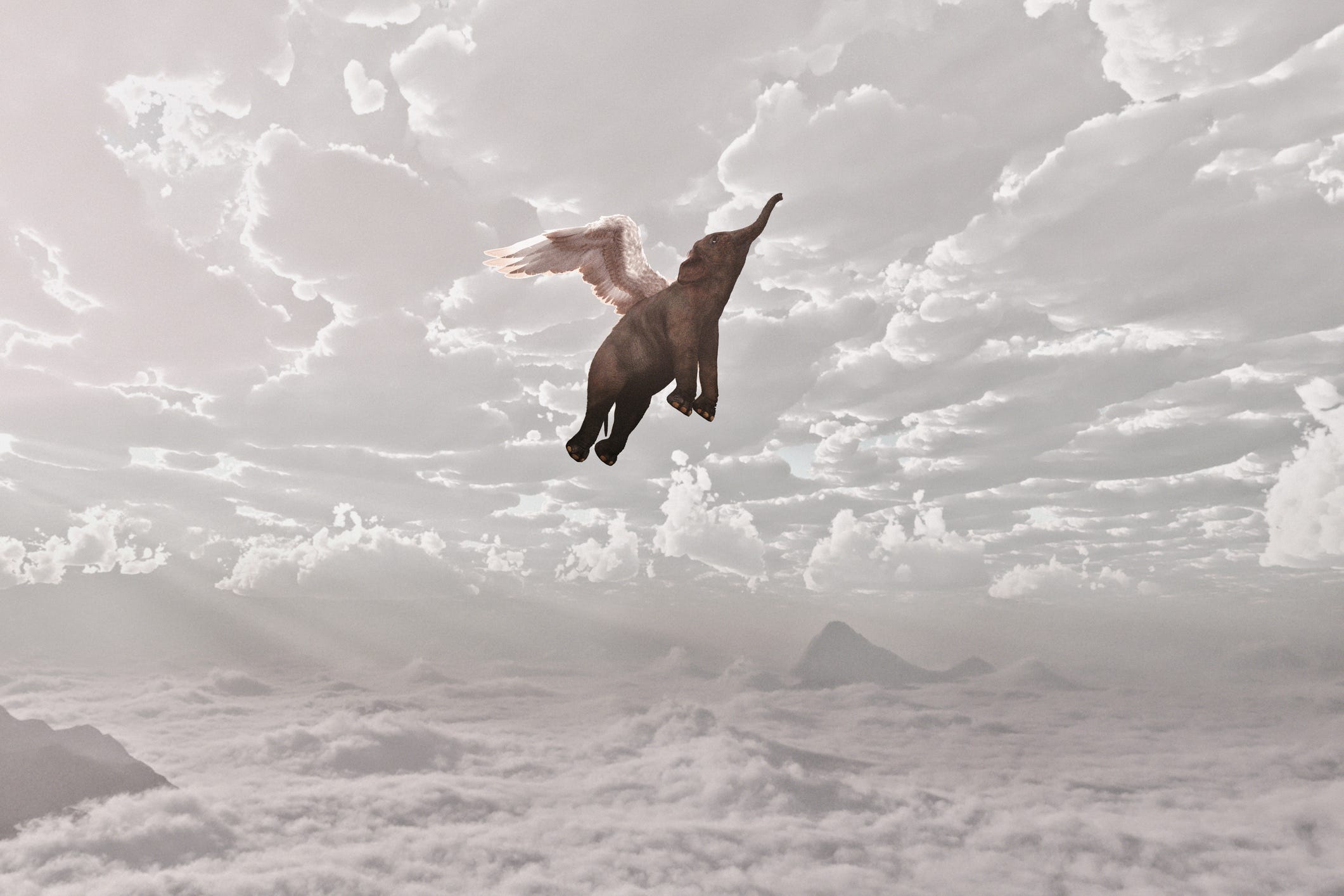
I take this to mean that, for any of us who aspire to be artists, the first job is to quickly burn through our disbelief and angst (and fear, and outrage) and start wondering things like: Why is this happening? What contributed to this? What, in my understanding, was flawed, flawed enough that I am now amazed and stunned? What are some of the small details of the moment that might make this come alive in writing?
The current moment is so strange, and things are moving so quickly, that I am finding it hard to shed this ongoing feeling of disbelief.
But there, up there, are the flying elephants – and they’re up there every day. How long do I want to stand here below, going, “I can’t believe it!”
So, the more powerful position is to go, “Right, flying elephants. Now: why is that surprising to me? How did I so poorly understand dogs, and how can I rectify that?”
Easier said than done, for sure, especially as the elephants get stranger and more numerous and seem, sometimes, to be blocking out the sun.
And yet…
I recall this poem, by the Russian poet Anna Ahkmatova, from her collection, Requiem.
INSTEAD OF A PREFACE
During the frightening years of the Yezhov terror, I
spent seventeen months waiting in prison queues in
Leningrad. One day, somehow, someone ‘picked me out’.
On that occasion there was a woman standing behind me,
her lips blue with cold, who, of course, had never in
her life heard my name. Jolted out of the torpor
characteristic of all of us, she said into my ear
(everyone whispered there) - ‘Could one ever describe
this?’ And I answered - ‘I can.’ It was then that
something like a smile slid across what had previously
been just a face.
**
You ask, “Amid all this turmoil, how must one stay committed to their art?”
Exactly, that’s a serious challenge.
For me, the hardest part is that fiction takes a long time, to do well, and it rarely directly addresses a political issue. I remember after 9/11, going back to the story I was working on (“Jon,” if I remember correctly) and feeling that I was fiddling around, painting designs on the baseboards of a house as the roof caved in. What was the use?
But now it seems to me that we have to accept, happily, that our work is just on a longer arc. We write it so that it will be able to be read profitably far into the future. (The story we’re working on over on the paid side, “Paper Pills ” by Sherwood Anderson, was written around 1910, and yet, over there, we’re getting all kinds of wisdom and power from it, even now).
I’ve found it helpful to try to disengage my artistic work from my political activities and writing – just to say, “You two may remain separate if you like.” And I’ve had the experience, both as a reader and a writer, of encountering a great work of art that was so deep, and so true, that it felt “political” in the very best way – it did some work in explaining some human tendency that, writ large, becomes political. I think, for example, of the Chekhov story “Enemies,” that we did awhile back and its depiction of how long-lasting enmity gets built. Or I think of the Granderford-Shepardson bit from The Adventures of Huck Finn, and the way that perfectly depicts the current political tribalism.
But, at other times, that resolution to keep politics and art separate doesn’t hold, and I write something that is more overtly political, because I just can’t help it (like, for example, “Love Letter” or “The Red Bow”) but even then I try to make sure that the piece rises out of mere advocacy and has some of the complications that makes it function as a work of art - this will mean that it fails to be “about” the thing I started out to say, and says something different instead, or in addition.
Beyond that, I wonder if we might take some comfort, dear questioner, in asking what, exactly, fiction does to us, as we read it. It seems to me that sometimes a good story can embody certain human qualities that, when we see them on the page, inspire us, and console us, by seeming to say, “Sometimes human beings get it right – you can, too.” This might be through the actions of a character (I think of the indomitable cheerfulness of Scrooge’s nephew) or sometimes it’s a quality being enacted by the writer herself – I think of the steely fearlessness of Katherine Ann Porter, as she leads us into those harrowing last lines of “He.” What confidence, what deep curiosity she’s showing, as she asks how things really are in the world.
And isn’t witnessing that somehow encouraging?
So, when I get rattled by the violence and cruelty of the world, I try to think, “Well, what I’d like to do is write one story that gives one person incrementally more confidence that the world is not totally insane, and people are not without redeeming qualities.”
Maybe I can do this with a single good joke, or a startling image; maybe I can guide a character through a difficult thought process; maybe just the idea that I worked through the writing of my story with love and care will make someone go, “Oh, yes, right: love and care are still out there.”
It’s kind of a cliché to say that writing makes us less alone, but look here, at this community. It has cheered me so many times, just the reality of this group of people who take time out of their busy lives to read, and think , and, most importantly, to communicate thoughtfully and kindly with one another, over and over, for four years now.
What we do and what we write matters, simply because (and as long as) there are people on the other end, receiving those actions and words and being, even subtly, changed by them.
Dear questioner – I wish you the best in your artistic life (and your real life!) and hope you’ll email me back if I’ve missed the mark here in any way, or if you just want to talk about this further.
Warmly,
George
P.S. Here’s some information on the upcoming tour of Vigil (which you can pre-order here, which is always very much appreciated) and, below, is a complete list of the moderators for all the events (and thanks, in advance, to all of them, for being willing to leap into this with me).
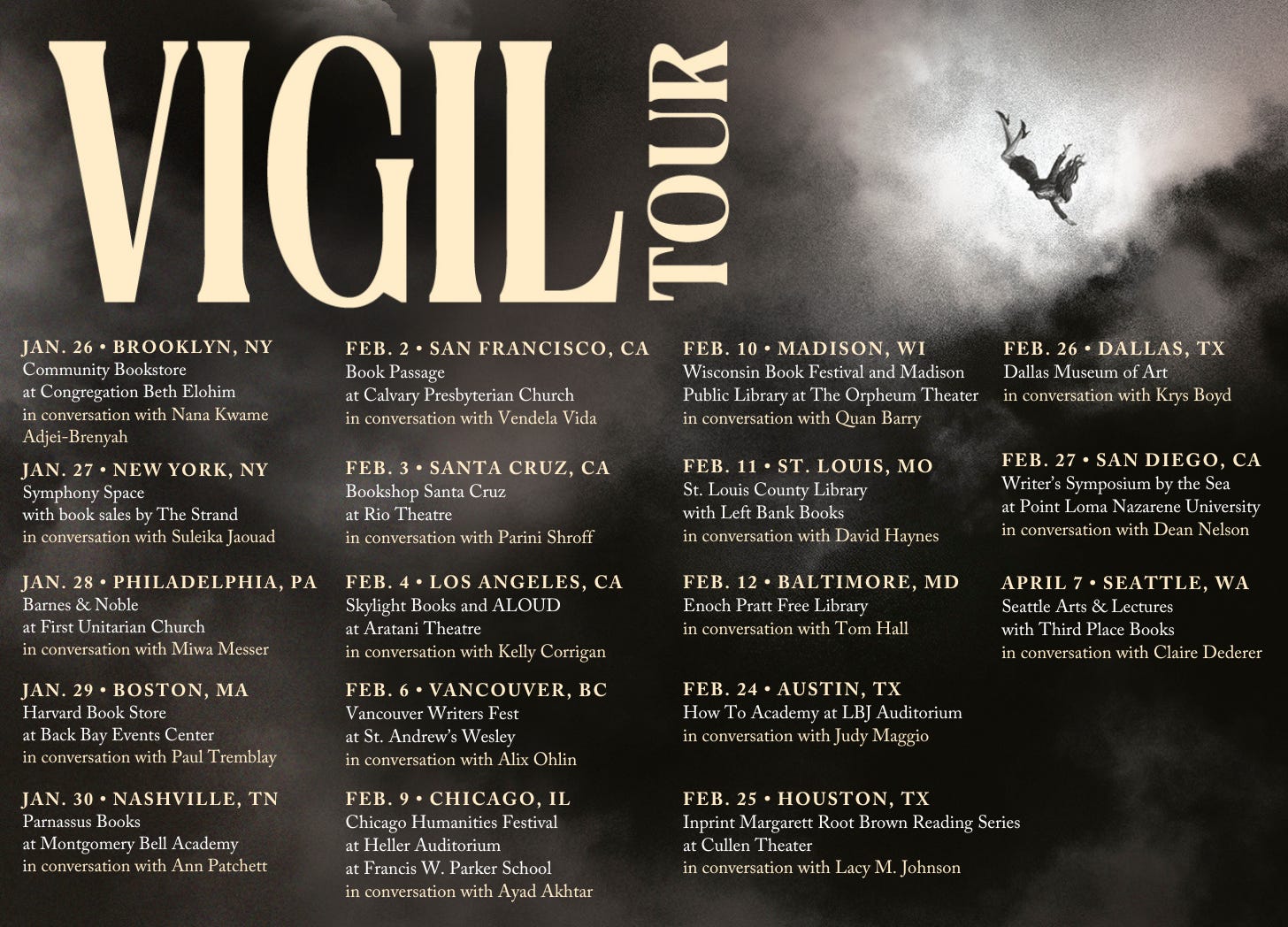
BROOKLYN, NY
Monday, January 26th, Community Bookstore at Congregation Beth Elohim, Brooklyn, NY. In conversation with Nana Kwame Adjei-Brenyah.
NEW YORK, NY
Tuesday, January 27th, Symphony Space with book sales by The Strand, New York, NY. In conversation with Suleika Jaouad.
PHILADELPHIA, PA
Wednesday, January 28th, Barnes & Noble at First Unitarian Church, Philadelphia, PA. In conversation with Miwa Messer.
BOSTON, MA
Thursday, January 29th, Harvard Book Store at Back Bay Events Center, Boston, MA. In conversation with Paul Tremblay.
NASHVILLE, TN
Friday, January 30th, Parnassus Books at Montgomery Bell Academy, Nashville, TN. In conversation with Ann Patchett.
SAN FRANCISCO, CA
Monday, February 2nd, Book Passage at Calvary Presbyterian Church, San Francisco, CA. In conversation with Vendela Vida.
SANTA CRUZ, CA
Tuesday, February 3rd, Bookshop Santa Cruz at Rio Theatre, Santa Cruz, CA. In conversation with Parini Shroff.
LOS ANGELES, CA
Wednesday, February 4th, Skylight Books and ALOUD at Aratani Theatre, Los Angeles, CA. In conversation with Kelly Corrigan.
VANCOUVER, BC
Friday, February 6th, Vancouver Writers Fest at St. Andrew’s Wesley, Vancouver, BC. In conversation with Alix Ohlin.
CHICAGO, IL
Monday, February 9th, Chicago Humanities Festival at Heller Auditorium at Francis W. Parker School, Chicago, IL. In conversation with Ayad Akhtar.
MADISON, WI
Tuesday, February 10th, Wisconsin Book Festival and Madison Public Library at The Orpheum Theater, Madison, WI. In conversation with Quan Barry.
ST. LOUIS, MO
Wednesday, February 11th, St. Louis County Library with book sales by Left Bank Books, St. Louis, MO. In conversation with David Haynes.
BALTIMORE, MD
Thursday, February 12th, Enoch Pratt Free Library, Baltimore, MD. In conversation with Tom Hall. (Note: There won’t be a signing at this event, sorry.)
AUSTIN, TX
Tuesday, February 24th, How To Academy with First Light Books, Austin, TX. In conversation with Judy Maggio.
HOUSTON, TX
Wednesday, February 25th, Inprint Margarett Root Brown Reading Series at Cullen Theater, Houston, TX. In conversation with Lacy M. Johnson.
DALLAS, TX
Thursday, February 26th, Dallas Museum of Art, Dallas, TX. In conversation with Krys Boyd.
SAN DIEGO, CA
Friday, February 27th, Writer’s Symposium by the Sea at Point Loma Nazarene University, San Diego, CA. In conversation with Dean Nelson.
SEATTLE, WA
Tuesday, April 7th, Seattle Arts & Lectures with book sales by Third Place Books, Seattle, WA. In conversation with Claire Dederer.
Well, Q, outside of a handful of family, and one hopes a few friends, the world doesn't give a damn if you write, or clean sewers, or till a field, or write code in a cubicle for the rest of your life. So you might as well do what you want. You will probably have to do what you want with some defiance too, some attitude, because in most of the real world pursing art is not valued. Not until you are successful by some external measures not your own, will your life and pursuit of art be seen as something worthwhile. This path implies uncertainly for sure, but nothing's certain anywhere anyway, so again, might as well be uncertain doing work you feel good about.
I am 77, and have worked at the writing craft all my adult life. Sometime for intense stretches, sometimes I lapsed when other things took over. A few of the kind people around this SC community might say I'm a good writer, but I've not been a successful writer by any measurable standards. But I think if you are an artist the choice what you do is made for you. If you reject that part of yourself you will not feel good, you will feel sick, in fact. I do think Story Club is a good place to hang out, because this is one place people do care.
Just wanted to share some commiseration with the questioner. I think a lot about a Paul Auster quote, which was something like: no one is asking you to write and the world will be fine if you don't, so really think about why you're doing it. It sounds cynical, but this gives me perspective. Writing and storytelling demand respect and are Important and Serious, but also they kind of are not. And so at least what I like to think is that the world won't live and die by my little stories, but it could in some way be different, as a result of my writing something which someone engages with in some way. Which is plenty for me.
We've also read a lot of writing from people who have written during some abjectly horrible periods of history. I wonder what advice Isaac Babel would have given before he was taken by secret police.