


Q.
Hi George! I hope you are well and looking forward to your upcoming book tour!
I love Story Club. Your generosity and warmth are a balm in a world that often feels both surprisingly savage and terribly fragile. You are a dear person.
My question is less about craft and more about commerce. Or maybe, when you strip away the details, at its heart, it’s really a question about existential dread? Maybe you can help me figure that out.
I came to writing late in life and rather recently. I knew, even as a little girl growing up in Chicagoland, that I wanted to be a writer. Instead, I became a divorced mother with two little girls and no education. Fast forward: The kids are grown, I have excellent health insurance, and I can afford groceries every week. (Yay!) So, now I am writing.
Of course, finding time to write can be difficult. I assume this is the case for all writers, especially those with full-time jobs outside of writing. Still, I’m not seeking encouragement to keep carving out time to write because to older people, I think, writing is like getting to go outside to play. Instead, I am wondering about spending time pursuing publication.
After all, time becomes more precious when there is less of it to lose.
Let’s say you, George, were the age you are now, but you were currently working at that engineering firm as a technical writer and counting the days until you could retire, hopefully, if all went well, at age seventy. Of course you would keep writing. But would you keep trying to get published? It seems incredibly time-consuming and perhaps a bit soul-crushing.
Sure, it looks like great fun to be in conversation with Deborah Treisman or signing books after a successful reading, but the effort to get there seems superhuman.
Perhaps, like tearing off a roof or curing a hangover with fast food, publishing may be a young man’s game.
Yes, the argument exists that one can simply write for the enjoyment of it and never seek publication but if I were a chef who spent a year or more perfecting recipes to prepare a feast, I would want, eventually, to share that meal with others. Besides, I think it may be an end point, publication, that encourages a writer to keep working until they reach that point. And then to begin again.
Can you offer any insight to either encourage or dissuade a writer from pursuing publication?
Warmest regards,
A.
Thank you for all of this and I’ll do my best…
This is one of those questions to which the best answer may be simply: “Well, what do you want to do?” (Or: “What do you want to do?” Being an artist is hard and it responds best to passion, even irrational passion. Becoming a better artist, in my experience, is a matter of learning, over and over, what you just plain like, no reasons needed, and then doing that thing as if it’s all that matters.
So, if you were my student, I’d likely just turn this question right back over to you. You don’t have to publish; there’s no shame in not publishing; but you can try to publish, and there’s no shame in that….
So, what do you want?
Only do that.

But I suspect that your answer is contained in your question, with this: “If I were a chef who spent a year or more perfecting recipes to prepare a feast, I would want, eventually, to share that meal with others.”
I agree with that. And it sounds like that’s your preference too.
So, the question is, how much time does it really take, to try to publish things?
I’m going to assume here that you don’t have an agent.
If that’s the case, my advice would simply be to set aside one afternoon every two weeks to deal with the business aspects – sending new stories out to magazines, maybe approaching agents or editors – whatever is needed.
Apart from that, don’t think about the publishing part at all. Just work on becoming the most interesting writer you can be.
Think of it as you would any other of the many household tasks we have to do to “earn” our writing time.
Back when I was working at the engineering company, I made a little matrix, with magazines along the vertical axis and the names of stories I thought were good enough to send out on the horizontal axis1.
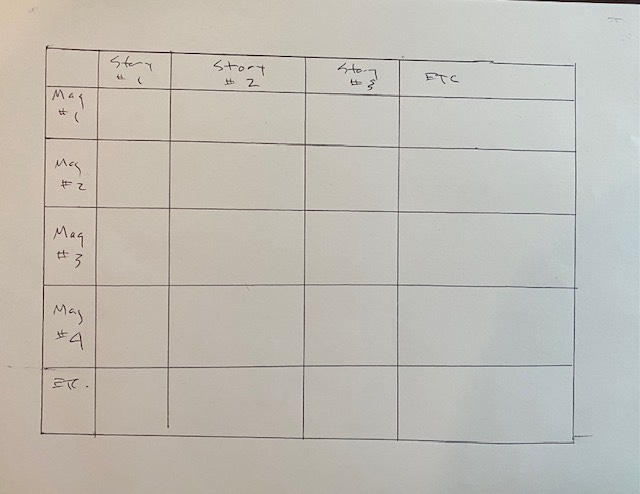
I’d spent some time assembling that short list of magazines I’d be thrilled to be in, and had informally ranked them – so, The New Yorker was at the top and then there were another ten or so places below that. I didn’t go beneath a certain (subjective) level – I wanted my work to be in places where it had a chance of being read. (At that time, that was one way you could get an agent – they were said to read certain higher-profile literary magazines).
So, as the rejections came in, I’d just write “R” in the appropriate box and move on to send the rejected story out to the next magazine.
And if a story got published (happy day!), I’d take it off the list and, as I could, replace it with a new, recently completed one.
You could make the same type of list for agents. (To make either list, I’d recommend this book, Writer’s Market, which lists editors, magazines, agents, etc, as well as advice on how best to make the approach. There’s also this one, in the same series, but geared more to finding an agent.)
The advantage of this approach is that it keeps a firewall between your creative worries (“How do I make this story better? Am I writing the right type of story? What’s the next scene in this thing?”) and your publishing worries (“Why won’t anyone take this story? Where should I send next?”).
It keeps things clean and separates the inevitable rejections from your working life, which, theoretically, should be full of fun and hope and joy and a reasonable level of self-encouragement. It is, I guess, a form of compartmentalization, that keeps the two energies from interfering with, or cross-contaminating, one another.
But it might also be useful for us to interrogate the effect of the prospect of publication on our creative lives.
For me, it’s almost purely excitement. I want to be published, always have. I love the process, and I like getting feedback (although I’m pretty defensive and don’t “love,” exactly, getting negative feedback or bad reviews – but I’ve learned to accept them as the cost of doing business, so to speak). Especially, I cherish the idea of something that I wrote going out in the world and having a positive effect on someone else’s day.
So, when I’m working, I definitely have an eye on audience, and I particularly love the prospect of a certain place in the text delighting or surprising my reader or making her laugh. That’s all an active part of my process – of free-writing and also of revision. If I didn’t have that anticipation going…I don’t know what it would be like to write, or how, exactly, I’d approach it.
But that might just be me. I mean, seriously. I’ve come to the conclusion that artists can tend to work out of some sort of odd, deep need, and for me that’s definitely true: I have a need to attract attention, be liked, make something that is fun or enlightening for another person, who will then appreciate it and admire me. Yes, I do, guilty, for sure.
But I always tell my students that, as hard as making art is, we have to use whatever we’ve got, and especially, maybe, whatever we’ve got in excess.
And, of course, it’s only fair to say that I’ve been very lucky in my publishing life – so what’s not to love? But even back at the beginning, when I was getting all rejections, I treasured the idea of someday having something accepted and having the magazine show up at my house, and all of that. Being published means something to me, I guess I’m saying, and I’d be loathe to give it up.
There is, of course, the very reasonable fear that sending stuff out and getting all rejections might start to take away from the pleasure of doing the actual writing.
But there’s also this, a form of tough love: when we send something out to a lot of places and no one wants it, that might be the world telling us something. It’s not telling us that we’re bad writers, or should quit, necessarily, but it is telling us that, for whatever reason, that particular work is failing to charm anyone. Why would it not? Well, that’s a deep question, for any artist. But asking that question can function as a doorway to one’s own form of originality. That is, rejection, and our acceptance of it as meaningful, can, maybe, make us see what about our current approach is merely habitual, or is due to, you know, “received wisdom,” (even if that wisdom was received here, at Story Club).
Rejection can be a needed shock to the system, I guess I’m saying.
“Now, wait a minute,” I can imagine some of you thinking, “Isn’t that attitude a bit market-subservient? What if the (vapid, shallow, consumer-tainted) market just isn’t getting me?”
A valid point.
Could it be that a writer is SO deep (transcendent, difficult) that no one is getting him? Possibly, of course, but I’d always want (in the spirit of Occam’s Razor) to check the more obvious explanation, which is just that our current approach is somehow failing to engage, because it is too cautious/careful/rule-bound/habitual.
And that can be a pretty exciting moment, when we are suddenly freed (by force, as it were) from whatever esthetic assumptions have been hovering, perhaps unnoticed, in that auto-cloud over our head as we write.
I’ve told the story of my first, 700-page, novel (La Boda de Eduardo) ad nauseum (referenced in the first answer here), but that really was a big moment for me. I’d spent the better part of a year on it, and asked Paula to read it and…it was not successful.
So: the world was not going to want it (as even my own wife couldn’t pretend to like it) and….now what? I still remember and cherish that feeling of total artistic clean-out…not a delusion or illusion left about what kind of writer I was or if I even was one at all – that is: total permission to start anew, with (now) the explicit goal of writing something that a reader would not only finish but love – something she couldn’t help but finish and be dazzled by.
That moment couldn’t have happened if I hadn’t 1) had the sincere ambition to publish, and 2) been bitterly disappointed that what I’d written wasn’t very good and would never be published (and I wouldn’t want it to be).
And then, bingo: freedom to start anew.
What do you think, Story Club? What does the quest to be published cost you? What does it give you?
And let me wish you all the happiest of New Years - the world can seem cruel, dark, discouraging, but, on the other hand, that gives us all work to do, in every moment (don’t be cruel, dark, or discouraged). :)
So, when you get Story #1 back, rejected, you fill in that box, with the date of the rejection. If the editor asked for another story, send one of the others and make a note of that. Then, send Story #1 to the next place. This can also be done, no doubt more gracefully, with a spreadsheet or some app I’ve never heard of - the point is to make it, you know, business-ish, so it stays the heck out of your creative life.
George, I wanted to add two other ways to frame rejection:
a) the journal has been inundated with submissions and must regretfully reject good material, or
b) the piece doesn't seem compatible with the issue the editors are putting together.
(Some editor likened assembling an issue of a journal to putting together a menu for a dinner--an amusing metaphor I try to keep in mind.)
I keep a file of the encouraging rejections I get--the ones that say, in essence, "You almost made it in to our pages this time; please send more"--and, when it's time for me to submit, I start with those journals.
When I got my first two acceptances, I was elated--surely, I thought, additional acceptances were just around the corner! I'm still waiting, and I'm still trying.
Why? As you aptly put it,
"I cherish the idea of something that I wrote going out in the world and having a positive effect on someone else’s day."
Yes!
I have my 3rd book coming out in February (a middle grade novel called BIRDY from Little Brown) and I have had to really compartmentalize (as George put it). I tend to get to excited and very much off track around publishing. I think I lost a full month of writing time when an essay i wrote appeared in the NYT ... I was very UP in anticipation, then woefully DOWN when life didnt change. Ever since then, I decided to guard the joy I get from writing against the vagaries of publishing. As Elizabeth Gilbert weote somewhere, try to assess your value as a writer by your dedication to craft rather than publishing. Look, obviously I like to get published too, and it does take forever (or so I've found it) but its still worth it to me. I dont know how old you are. I got my mfa at 49 and my1st book came out at 52. Im 61 now with my 3rd book. Im playing the long game I guess, and you can too. My father published his first book at 69 and it won a big award and gave him.about 10 years of great fun